Wednesday, April 10, 2024

Protecting Yourself from STIs

With the spread of sexually transmitted infections (STIs) on the rise, we want to make sure every person in our Circle of Care has the information they need to live a safe and healthy life. April is STI Awareness Month, so we're breaking down the most effective ways to prevent contracting an STI and the symptoms that require a prompt visit to your OB/GYN.

What are STIs?
Sexually transmitted infections (STIs) are infections or viruses spread from person to person by intimate physical contact or through sexual intercourse. Common STIs include chlamydia, gonorrhea, HPV, genital herpes, and syphilis.

Aside from colds and the flu, STIs are the most common contagious (easily spread) infections in the United States. The American College of Obstetricians and Gynecologists reports that there are millions of new cases each year, so it's important to know the facts when it comes to protecting your body.

How Can I Protect Myself?
The good news is, that there are a lot of different ways you can protect yourself. You can reduce your risk of contracting an STI by:

  • Limiting your number of sexual partners. 
  • Using protection (such as condoms) every time you have vaginal, oral, or anal sex. 
  • Making sure you are up to date on all of your immunizations. Vaccinations are available for hepatitis B as well as some forms of HPV.

Regular screening is also key to catching an STI early if you do contract an infection.

"It's recommended that sexually active women between the ages of 15 and 25 have at least annual gonorrhea and chlamydia screening," says Dr. Valary Gass of Women's Care of Wisconsin.

There are some STIs that can be cured but could cause long term problems like pain and infertility, so early detection is important.

"Additional screening can be offered for HIV, syphilis, and hepatitis B or C," Dr. Gass says.

What are the Most Common Symptoms of an STI?
Some of the most common STI symptoms to look out for include:

  • A burning sensation when urinating
  • Sores, bumps, rashes, or blisters in the genital or anal area
  • Abnormal discharge 
  • Redness or swelling in the genital area
  • Pain in the pelvic or abdominal area
  • Pain, soreness, irritation, or other discomforts during intercourse
  • Bleeding after intercourse
  • Recurring yeast infections 

If you believe you are at risk for contracting an STI, it is very important to schedule an appointment with your healthcare provider.

During pregnancy, STIs can also cause harm to the fetus. If you are pregnant and you or your partner have had -- or may have -- an STI, be sure to inform your doctor so you can work out a treatment plan that will decrease the chances of your child getting the infection.

Schedule An Appointment
If you have concerns about STIs or believe you need screening, please talk to your healthcare provider," Dr. Gass says. 

At Women's Care, our providers are devoted to you and your health. That means having the most advanced techniques, up-to-date educational information, and compassionate, caring staff.

To schedule an appointment with one of our providers to discuss STI screening or any other health related topic, please call or text us at 920-729-7105.


Wednesday, April 3, 2024

Meet Gretchen Augustine DO, Women's Care of WI

“Pretty much every visit I have with a patient starts the same way,” said Gretchen Augustine. “I ask them to tell me in their own words, in their own time, why they are here.”

Perhaps that’s why the Women’s Care of Wisconsin OB/GYN develops such a strong connection with them.

“Those first minutes in a first appointment are crucial,” said Augustine. “My patients know their bodies better than anyone else, so I provide them the time, opportunity and space to share what they’ve been through. Details they provide can be very powerful.”

The Michigan native actually started her career in journalism. Her decision to follow a very different path was rooted in being able to connect with people at a deeper level. She returned to school to pursue a degree in osteopathic medicine (Doctor of Osteopathic Medicine, or DO). That means she’s trained exactly as an MD, but with additional training in manipulative medicine.

“An osteopath is trained to view the patient holistically, to take care of the patient’s mind, body and spirit,” Augustine said. “It’s about finding and treating the root causes of issues rather than simply assigning a medicine to fix a problem.”

A staunch advocate for patient empowerment, Augustine insists that the education of those she serves be a top priority in her practice.

“It’s important patients understand the best options available to them,” said Augustine. “And they need to be comfortable with the treatment and have confidence that it is right for them and that it will be successful.”

Fundamental to women’s medicine, said Augustine, is developing relationships.

“We take care of women throughout the spectrum of their lives, and those of us in the field embrace that role,” she said.

Her patients describe Augustine as genuine, kind, astute, supportive, and funny.

“I laugh with my patients a lot, and I think that’s important,” said Augustine. “Most important of all, though, is that my patients feel heard and know that we’ll be working together on a plan to get them to where they want to be.”

Dr. Gretchen Augustine sees patients at Women's Care of Wisconsin locations in Appleton and Shawano. To schedule an appointment with Dr. Augustine, please call or text 920.729.7105.

Monday, March 11, 2024

March is Endometriosis Awareness Month

Are you doubling over in pain during your period? Do you have cramps you just can’t seem to shake throughout the month? For 1 in 10 women, these killer cramps are a symptom of endometriosis. Although endometriosis affects 190 million women worldwide, many go undiagnosed. March is Endometriosis Awareness Month and the perfect time to educate about this painful, chronic disease. Here’s what you need to know to find out if endometriosis might be affecting you.

What is Endometriosis?

"Endometrial cells are what make up the lining of the uterine cavity," Women's Care of Wisconsin's Dr. Therese Yarroch explains. "In women with endometriosis these cells are found outside of the uterus, where they cause inflammation. Sometimes referred to as 'endometrial implants,' they can be found on the ovaries, fallopian tubes, bladder, bowels and anywhere else in the pelvic region. This inflammation can result in pain and significant scarring to the surrounding tissue."

What Causes Endometriosis?

"We do have evidence that there is an increased risk of endometriosis in women with heavy menstrual bleeding and longer or more frequent menstrual cycles," Yarroch says. "Doctors also know that estrogen plays a role and women who have a close female relative with endometriosis are 5-7 times more likely to have it themselves."

Spotting the Symptoms

"Although it’s a common misconception that endometriosis only occurs in women over the age of 20, the truth is that the disease can develop as soon as a girl gets her first period and can span the rest of a woman’s reproductive years," Yarroch says. "The most common symptom of endometriosis is pelvic pain. While this pain usually coincides with menstruation, some women can experience this symptom throughout their entire cycle.”

Other symptoms to look out for include:

  • Pain during or after sex
  • Severe cramps that do not go away with NSAIDs or that impede the activities of your everyday life
  • A heavy menstrual flow
  • Periods that last longer than 7 days
  • Nausea or vomiting
  • Urinary and bowel disorders
  • Difficulty getting pregnant

Not every woman will experience all of these symptoms, but approximately 30%-40% of women who have endometriosis will experience issues with fertility.

Getting a Diagnosis

The only way to know for sure if you have endometriosis is through a surgical procedure called laparoscopy. Laparoscopy uses a small telescope that is inserted into the abdomen through a very small incision. It brings light into the abdomen so the doctor can see inside.

Treating the Symptoms

There are a wide range of treatment options for endometriosis and your doctor may suggest a less invasive methods before ordering a biopsy. Some of the most common treatments include:

  • The use of NSAIDs, such as ibuprofen (Advil, Motrin) and naproxen (Aleve). NSAIDs can help relieve or lessen the pain caused by endometriosis by stopping the release of prostaglandins, one of the main chemicals responsible for painful periods. While NSAIDs can help manage the pain-related symptoms of endometriosis for some women, it’s not effective in every case.
  • Birth control methods such as the pill, the patch and the ring are often helpful to treat the pain associated with endometriosis because they reduce heavy bleeding. This method works best for women who only have severe pain during their period and not during the rest of their cycle.
  • Progestins are recommended for women who do not get pain relief from or who cannot take hormonal birth control that contains estrogen (such as smokers). This synthetic form of the natural hormone progesterone is available by prescription as a pill or an injection.
  • GnRH therapy uses medicines that work by causing temporary menopause. The treatment actually causes the ovaries to stop producing estrogen, which causes the endometriosis implants to shrink.

For some women, surgery may be the best treatment method. While there isn’t a cure for endometriosis yet, it is possible to remove some of the scar tissue and lesions with surgery.

If you have endometriosis, surgery could be an option if you:

  • Have severe pain
  • Have tried medications, but still have pain
  • Have a growth or mass in the pelvic area that needs to be examined
  • Are having trouble getting pregnant and endometriosis might be the cause

"It is important to note that there are other conditions that can cause many of the same symptoms as endometriosis," Yarroch says. "An OB/GYN can help determine if endometriosis is the appropriate diagnosis."

So What Now?

"Endometriosis can have a significant impact on a woman's life. Fortunately, there are treatment options available to manage pain and minimize recurrence," Dr. Yarroch says.

Wednesday, March 6, 2024

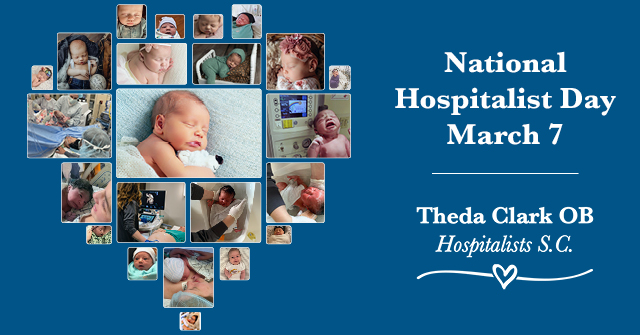
OB Emergency Dept/Hospitalist Program Debuts

Last month, ThedaCare announced the opening of their new Obstetrical Emergency Department (OB-ED) and Hospitalist Program. Providing specialized care to expectant mothers, babies and families, the new program is part of the update to the Theda Clark Peters Family Birth Center through the $100M investment to modernize the Neenah campus. The addition of these hospital-based women’s services can help ThedaCare continue to provide comprehensive, safe care for expectant mothers and babies in Northeast and Central Wisconsin.

The OB-ED, staffed by board-certified and board-eligible specialists, operates around the clock and provides care for pregnant women facing obstetrical challenges.

“Through this program, a trained physician will evaluate every patient, and our goal is that expectant mothers can leave the hospital with peace of mind, focusing on the health and well-being of their family,” said Dr. Eric Eberts, Department Chair of the ThedaCare OB-ED and Hospitalist Program. “Having an OB-ED and Hospitalist Program can redefine the standard of women’s care in the hospital setting to help continue safe patient care.”

The creation of an OB-ED and Hospitalist Program is an important milestone in ThedaCare’s history. For 115 years, ThedaCare has provided care for the people in Northeast and Central Wisconsin, an opportunity made possible more than a century ago when Theda Clark Peters directed a significant portion of her estate to be used to build a hospital in Neenah so that people in the community would have local access to medical care.

Through the program, women who are more than 16 weeks pregnant now bypass the emergency department and go directly to an obstetrical triage area located in the Family Birth Center at ThedaCare Regional Medical Center-Neenah. This program will supplement the care of a woman’s OB provider; her doctor will continue to provide care in the facility. The program ensures a highly specialized doctor to be available to evaluate a woman immediately, without waiting for the patient’s doctor to arrive onsite, or providing a consultation over-the-phone. 

Eberts noted that the program aims to provide support for ThedaCare’s other hospitals, including those in rural communities via telehealth consultations.

“The OB-ED and hospitalist program can help ensure that expectant mothers continue to receive timely, specialized care for themselves and their babies,” Eberts said. 

Learn more via NBC 26’s exclusive report, which includes Dr.Eberts’ special connection to Theda Clark Peters.


Meet Pa Kou Thao, Nurse Practitioner

You don’t question an epiphany. Such a revelatory moment can only be absorbed, followed.

Nonetheless, Pa Kou Thao did question the timing of hers.

“I was a year from graduating with my business degree when I got to be part of my nephew’s birth,” said the newest provider at Women’s Care of Wisconsin. “Two weeks before the semester started and I was like, “Yeah, I don’t think this is what I want to do.”

Thao immediately threw her business classes into a minor, switched to a nursing major, and started fresh.

It was a decision she knew she had to make. She never wavered, although a thought did cross her mind every now and then.

“There were times when I said to myself, ‘I could be getting my master’s right now.”

Thao pursued her calling, earned her nursing degree and became a labor and delivery nurse. Later, she would continue her studies and achieve her certification as a Family Practice Nurse Practitioner with a focus on women’s health.

You wouldn’t know it by looking at her, but she’s 17 years into her healthcare gig. With that kind of experience, no surprise there wasn’t a nanosecond of hesitation when asked about her philosophy of patient care.

“Everybody who walks through the door to see me is like a family member, right?” said Thao. “I'm going to treat you like you are my family, because that's how I would want somebody to treat any family member of mine if the roles were reversed.”

Not that she wouldn’t have had great success in the business world and made her mark there, but Thao relishes the impact she can make as a healthcare provider.

“My work is so fulfilling,” said Thao. “I love being able to develop long lasting relationships with my patients, people who come to see me year after year because we have that bond of trust.”

Thao is a highly positive force—easygoing, personable, empathetic. It’s easy to see why her patients love to see her.

Well, she had a bit of a different spin on that one.

“Almost every patient that comes in is like, ‘I hate these yearly exams!’ And I always tell them nobody enjoys them! But it’s so great they come in—it’s so important to take care of yourself and make sure you're keeping yourself healthy.”

A provider who effortlessly turns a first visit into a fast friendship, Thao loves connecting with her patients and using her expertise to make a difference in their lives.

Clearly the path of someone who followed her heart.


Wednesday, February 14, 2024

Incontinence: More Common Than You Think

Did you know that 50% of women have incontinence at some point in their life? Here’s what you can do to take control.

Incontinence is the loss of urine in an uncontrollable fashion. There are many reasons as to why people have it. Some of them are very easy to treat successfully and are easily cured, and some of them are very challenging to cure. But we can usually get significant improvement with treatment. Incontinence is one of my favorite conditions to see a new patient with; I can often cure them outright and almost always make a big improvement for them with fairly little intervention.

Most people put up with it and hope that it’s going to get better, or put if off until tomorrow, only to realize that several years have passed and it’s only gotten worse.

In generations past, people have looked at the loss of urine as a normal part of aging or normal consequences of childbearing, both of which I think are mistakes. What I would encourage people to think about is the fact that although incontinence is not painful, it’s not normal. People really don’t like to deal with it because it’s embarrassing. But they should realize, it’s very common, and often very easy to treat.

However, correctly treating incontinence means also that you have an understanding of what the true diagnosis is, very much like a headache. There are many different causes for it and the headache itself is usually a symptom of an underlying abnormality of some type, just as incontinence can be caused by many different things. 

Relief for women dealing with bladder control issues typically takes one of three routes:

  • It can be as simple as a 10-minute outpatient procedure or a prescription for  medication.
  • It may require a combination of therapies to get someone to a much better function.
  • Sometimes we need to treat an underlying, undiagnosed urinary tract infection, which should be evaluated further, as it could possibly be a sign of other diseases such as MS or diabetes. 

There are varying levels of incontinence, all of which can be diagnosed and treated to help you return to a normal, active lifestyle.

Spasm and bladder irritability:

  • Conditions where a person is urinating frequently and up a lot at night with a sudden sense of urgency (similar to the television commercials you see).
  • Tends to be a neurologic, irritational aspect to the bladder.
  • There are a handful of different medications that are typically used to treat this.

Stress incontinence:
  • People leak a small amount of predictable urine every time they cough, sneeze, lift or jump.
  • Will not get better with time.
  • Often times this can be treated effectively with proper Kegel exercises, but a lot of times that treatment requires ongoing and continuous exercise by the person, and sometimes even then it won’t hold up over time.
  • Should that fail, we can proceed with a small, 15-minute, outpatient procedure that is very successful (such as some type of sling procedure), which in the past was a very big surgery and nowadays really can be done quickly with a very fast return to full function status.

When incontinence affects how you function, what you’re doing, your clothing choices or travel plans, it’s just a shame not to get an evaluation and treatment—because so often, it is actually fairly easy to fix with many different treatment modalities. 

Suffice it to say, there are many treatments for many different causes in the many unique types of patients out there. But I would encourage readers to not for a minute think that this is a normal part of aging and something they simply have to “put up with.”  I would encourage them to seek medical evaluation and intervention, because if you’re thinking about the fact that you’re leaking urine, then it is probably affecting you on a daily basis.

Dr. Eric Eberts is an Obstetrician/Gynecologist at Women’s Care of Wisconsin. Contact Dr. Eberts at 920-729-7105.

The providers at Women’s Care of Wisconsin are devoted to you and your health. That means having the most advanced techniques, up-to-date educational information and a compassionate, caring staff. Our providers offer a well-rounded approach to your OB/GYN care, one that meets both your physical and emotional needs throughout every phase of your life. We call it our Circle of Care. And it begins with you.

Wednesday, February 7, 2024

Swift Connects with Patient in the Valley

No, not that Swift. A different Swift. But a Swift nonetheless. And there’s a Taylor in it too.

But not a Kelce. There is a reference to pro football, however.

This all started due to a Facebook post, one of those that immediately grabs your interest. It went like this:

With my first baby, I had some doctor changes, due to my previous doctor being injured. I was supposed to meet Swift before my induction date, but our baby had different plans and came a little early. The nurses called Swift when I was in labor and she agreed to come and deliver. I met her for the first time as I was delivering. Swift was sweet, kind, and ready to help me deliver my first baby. Fun fact: my nurse's name was Taylor!!

We had to know more. And Amanda Prodell was kind enough to share her story.

It’s quite the tale . . .

. . . Ready for it?

This was about three years ago. My really good friend is a Swiftie. Yeah, to the point where she wrote Taylor Swift a letter inviting her to her wedding. Never came. But that’s not my story. So, my husband and I struggled with fertility for quite some time, and we were seeing another provider in the Fox Valley area for fertility. In October 2019, we miscarried with our first one. I tried some more fertility treatments, and nothing was working. I just started a job at a different school, so I decided to give my body a break, start in the spring kind of thing. Well, COVID hit in March of 2020, and everything was shut down.

Literally a week after the COVID shutdown we conceived. My body was just able to do what it needed to do. Guess we just needed a little COVID in our lives to get pregnant.

In November of 2020, I had an insurance meeting at work and they said that even though your doctor might be in network, you had to make sure the hospital was in network too. Turned out my doctor had switched to a hospital that wasn’t in network for me, and the out-of-pocket deductible we would have to pay wasn’t going to happen.

I heard from different friends who said I should go to Women’s Care and their place on Ballard was really close to where I work, so I called them and told them my situation and they asked who I’d like to see. I’m pretty easygoing, so I let them choose. They got me set up with a provider that I saw a couple of times until she cut her hand and was taken out of commission. I already had an induction date with her for December 26th, a Saturday. Turns out on call that weekend was Dr. Swift. I never met Dr. Swift and didn’t really know anything about her, but I was game.

I was supposed to meet Swift on the Wednesday before the induction, but my little guy decided to come on that Monday. When the hospital staff asked me who my doctor was, I told them I really didn’t have one but that Swift was supposed to do the induction on the 26th. They gave her a call; she came up at 12:45 on December 21st and that was my first time meeting her. 

Swift was there for probably 45 minutes; she delivered my son, Keegan, then we chit chatted, and then she was gone. She was so great and really came through for me after all the craziness with my whole pregnancy. It just so happened though my delivery my nurse’s name was Taylor (and she was there for me too:)

Women’s Care in general just stepped up to the plate and really made me comfortable with all the changes that were going on.

Then when I got pregnant with my second (we got pregnant naturally), I called Women’s Care again, but by that time Swift had moved to her new location, which I probably could have made work, but coming to Appleton was just a lot easier. Told Women’s Care my situation; again, I was asked who I wanted to see. Honestly, I was really open to anybody who was honest and upfront. And I got Dr. Reed.

So I met with Reed throughout my whole pregnancy, and it was a really good experience. She really cares for her patients. She checked in on me after delivery. I was really happy I got her because it was kind of iffy. I didn't want to be induced at all, even though I had an induction date with one of her co-workers right on the books. But I knew that this little guy was probably going to come earlier than his due date due to my son coming earlier. Reed delivered our second, Tatum, on December 22nd. So they're three years and a day apart.

Oh, the football part. With Keegan, our birthing room was 412. I was like, this is perfect, Brett Favre and Aaron Rodgers. For Tatum, they put us in Room 410. My husband kind of wanted to be in 412 again, but I was thinking Brett Favre and Jordan Love, so we stuck with 410.